Oval Face Shape
Longer than wide, with a forehead slightly wider than a softly rounded jaw.
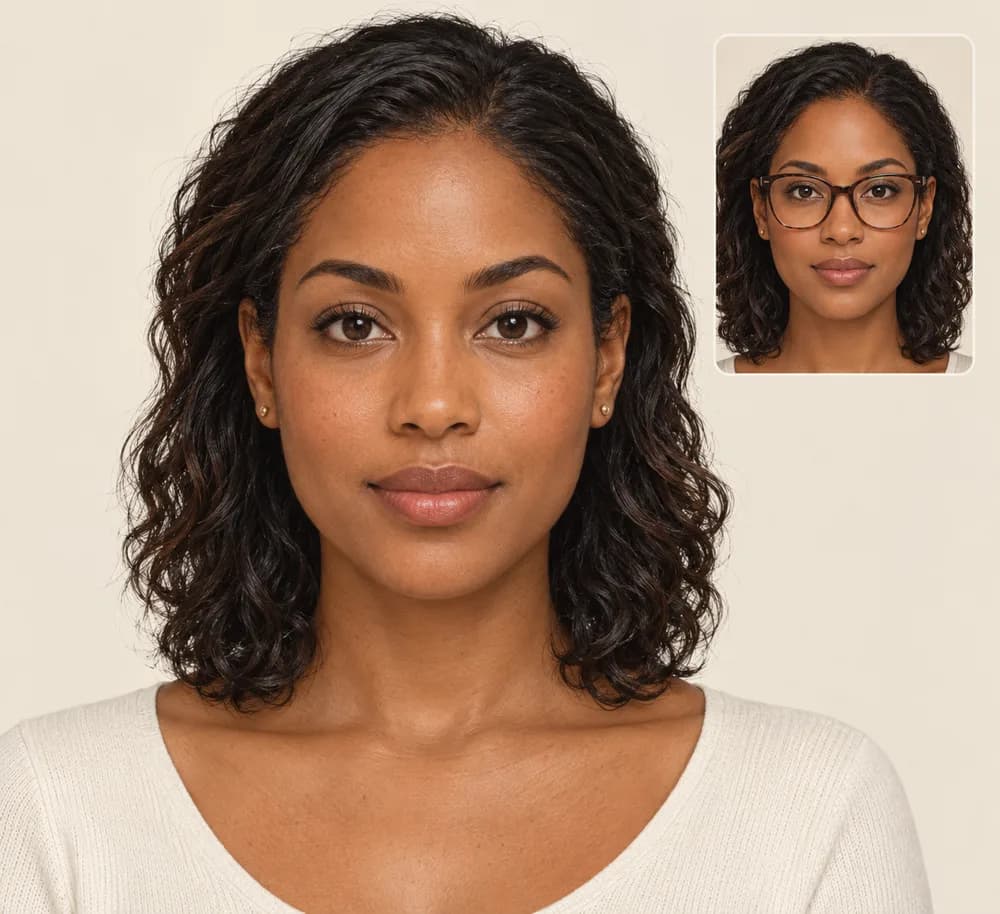
By Zohaib Hassan · Published
This is style guidance, not a medical or scientific assessment. Face-shape categories are a practical shorthand for proportions, and many faces sit between two of them. See our disclaimer.
What is a oval face shape?
An oval face is noticeably longer than it is wide, and it narrows gently from the cheekbones toward a rounded chin. The forehead is a touch wider than the jaw, and there are no strong corners anywhere on the outline.
How to tell if your face is oval
Face length is roughly 1.4 to 1.5 times your cheekbone width. Your cheekbones are the widest line, the forehead comes a close second, and the jaw curves rather than turning a corner.
Check the outline in a straight-on, eye-level photo with your hair pulled away from your forehead and jaw. Then measure twice: small differences in tape placement can move a borderline face toward a neighbouring shape. Many people genuinely sit between two categories.
- The face is clearly longer than the cheekbone width, but not extremely long.
- Cheekbones are usually widest, with the forehead close behind.
- The outline tapers gradually toward a rounded jaw and chin.
- No single area visually dominates the outline.
Oval face measurements
An oval result usually has a length-to-cheekbone ratio around 1.4 to 1.5, a forehead slightly narrower than the cheekbones, and a jaw narrower again. Ratios are guides rather than biological boundaries: a face can still read oval when the sides taper and the jaw is soft.
Measure the widest part of your forehead, the outer cheekbones, the jaw corners and the distance from hairline to chin. Keep every number in the same unit. If two measurements are close, repeat them and use the visible outline as the tie-breaker rather than forcing a precise cutoff.
Oval vs oblong
An oblong face is longer still (about 1.55 times the width or more) and its sides run straight down, so the forehead, cheekbones and jaw measure almost the same. An oval tapers.
For a direct comparison, read the oblong face shape guide.
Oval face shape hairstyles
Oval face shape hairstyles do not need to correct a dominant width. The useful question is whether a cut preserves the gentle taper or makes the face look substantially longer. Hair texture and density should decide the exact cut.
Collarbone layers
Movement around the cheekbones and jaw shows the natural taper without adding excessive height.
Soft bob or lob
A jaw-to-shoulder length frames the outline while working with straight, wavy or curly hair.
Curtain or side-swept fringe
A broken fringe adds interest across the forehead without heavily shortening it.
Short textured crop
Texture keeps a short style dimensional; moderate top height avoids stretching an already long outline.
Because nothing on the outline needs balancing, styling choices are mostly about your features and personal taste. The one thing to watch is very long, flat hair, which can stretch the face toward an oblong look. These are balancing ideas, not rules. Repeating your natural geometry can be just as intentional as contrasting it.
Glasses for a oval face
The best glasses shape for an oval face is usually sized to the face rather than selected by one rigid category. Both curves and angles can work.
Soft square frames
A little structure contrasts the rounded jaw without becoming severe.
Wayfarer-style frames
Moderate width and an angled upper line relate well to the cheekbones.
Round frames
Curves repeat the softer outline when the frame is correctly scaled.
Correct scale
Frames much wider than the face or very shallow can disturb otherwise even proportions.
Before buying, check that your pupils sit comfortably within the lenses, the bridge does not slide or pinch, and the temples do not press into the sides of your head. Prescription, comfort and correct optical fit take priority over face-shape advice.
Necklines, earrings and facial hair
Details near the face work by adding direction. Open or V-shaped necklines emphasize vertical space; crew and boat necks add a stronger horizontal. Longer earrings draw down, while studs and clustered shapes hold attention near the cheekbones. Facial hair can soften, widen or square the visible jaw, so assess the bone underneath first and then choose whether to repeat or change that outline.
Common mistakes
- Calling every balanced face oval without measuring length.
- Confusing oval with oblong because both are longer than wide.
- Ignoring curl pattern, density and upkeep when choosing a haircut.
- Treating oval as an ideal rather than one proportion pattern.
How this guide was created
This guide uses the same four-part framework on every shape page: face length, forehead width, cheekbone width and jaw width, with jaw curvature used as a visual tie-breaker. Styling suggestions are included only where their visual effect can be explained—for example, adding width near the jaw or creating a vertical line. The portrait above is an original generated editorial illustration, not a photograph of a real person and not proof that every oval face looks the same.
Face shape is a styling category, not a medical diagnosis, personality indicator or attractiveness score. Age, body composition, dental structure, expression, camera lens and hairstyle can all change how the outline appears. If a sudden or painful facial change concerns you, styling guidance is not a substitute for advice from a qualified health professional.
Oval face shape FAQ
Is an oval face the same as a long face?
No. An oval face tapers and has moderate length. An oblong face keeps straighter sides and has a stronger vertical proportion.
Do bangs suit an oval face shape?
Yes. Curtain, side-swept, textured and blunt bangs can work; choose according to texture and how much visible length you want.
Can an oval face wear round glasses?
Yes. Check width, bridge fit and pupil position instead of rejecting a frame by shape alone.
Compare your result
Use the face shape detector for a private, on-device photo estimate, or follow the four-measurement face-shape method. Face shape is separate from Kibbe image identity; the face shape and Kibbe guide explains how to use both without treating one as a shortcut for the other.