How to Determine Face Shape at Home: A Step-by-Step Guide
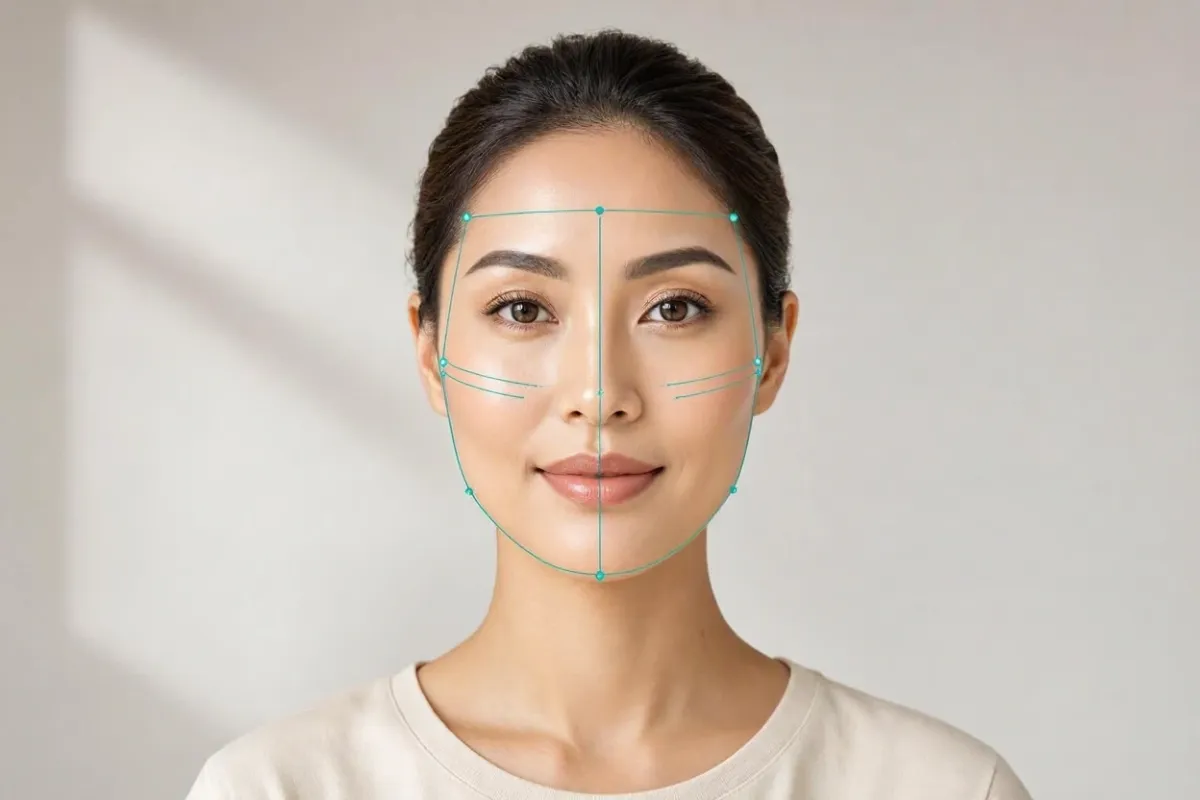
To determine your face shape, measure four things (forehead width, cheekbone width, jaw width and face length), divide them to get three ratios, and compare those ratios with the six common shapes. It takes about ten minutes with a soft tape measure and a mirror, and this guide shows exactly where to measure and how to read the numbers.
By Zohaib Hassan · Published
This is style guidance, not a medical or scientific assessment. Face-shape categories are a practical shorthand for proportions, and many faces sit between two of them. See our disclaimer.
What you need
- A soft tape measure, the fabric kind used for sewing. A piece of string and a ruler works too.
- A mirror at face height, in good, even light.
- A hair tie or headband to keep hair off your forehead, temples and jaw.
- Somewhere to write the four numbers down, such as paper or your phone's notes.
A second person helps, especially for face length, but you can do it alone. Keep your head level and your face relaxed. Smiling widens the cheeks and lifts the jaw line.

How to tell your face shape in six steps
- 1
Measure your forehead
Pull your hair back. Measure straight across the widest part of your forehead, usually about halfway between your eyebrows and your hairline, from the edge of the hairline on one side to the other.
- 2
Measure your cheekbones
Find the highest, outermost point of each cheekbone, just below the outer corner of each eye. Measure straight across the face between those two points.
- 3
Measure your jaw
Find the jaw corner on each side, the point below your ear where the jaw turns toward your chin. Measure straight across between the two corners.
- 4
Measure your face length
Measure from the centre of your hairline straight down over your nose to the tip of your chin. Keep your mouth closed and your head level.
- 5
Work out your ratios
Divide face length by cheekbone width, then divide forehead width and jaw width by cheekbone width. These three numbers describe your outline independently of your overall size.
- 6
Match the ratios to a shape
Use the decision path: compare length to width first, then find the widest of the three widths, then check whether the jaw curves or turns a corner.
Getting each measurement right
Forehead
The forehead is the measurement people most often get wrong, because hair hides its edges. Pull hair right back and measure between the points where the hairline meets the temples, at the widest level. If you have a high or receding hairline, measure at roughly the middle of the forehead rather than at the very top.
Cheekbones
Press lightly with your fingertips to find the bone, not just the fullest part of the cheek. The point you want sits roughly level with or just below the outer corner of the eye. Measure in a straight line across the face rather than following its curve. This measurement is the reference that the others are compared with, so take it twice.
Jaw
Clench your teeth lightly and you will feel the jaw muscle bulge just in front of the jaw corner. Relax, then place the tape at the corner of the bone below each earlobe. If you have a soft jaw and cannot find a clear corner, that is itself a clue that points toward a round, oval or heart shape.
Face length
Run the tape from the centre of the hairline, over the bridge of the nose, to the bottom of the chin. Because the tape follows the curve of the nose, this reads slightly longer than a straight-line measurement. That is fine, because the rules below allow for it. Keep your mouth closed and look straight ahead.
Turning measurements into ratios: a worked example
Ratios matter more than raw numbers, because they describe proportions regardless of how big your face is. The figures below are an illustrative example, not data from a real person.
| Measurement | Example | Ratio |
|---|---|---|
| Forehead width | 13.0 cm | 13.0 ÷ 14.0 = 0.93 of cheekbone width |
| Cheekbone width | 14.0 cm | Reference width |
| Jaw width | 11.6 cm | 11.6 ÷ 14.0 = 0.83 of cheekbone width |
| Face length | 20.3 cm | 20.3 ÷ 14.0 = 1.45 × cheekbone width |
A length of 1.45 times the width puts this face in the moderately long band. The forehead (0.93) is a little wider than the jaw (0.83), and neither is wider than the cheekbones. If the jaw curves rather than turning a corner, that is a textbook oval face shape.
The decision path
Work through these in order. Each step narrows the field, and the thresholds are approximate, so if you land right on a boundary, check both neighbouring shapes.
- 1. Is your face length 1.55 times your cheekbone width or more, with forehead, cheekbones and jaw all within a few percent of each other? You are probably oblong.
- 2. Is your face length 1.25 times your width or less? Your face is compact. If the jaw turns a clear corner, you are probably square. If it curves smoothly, you are probably round.
- 3. Otherwise your face is moderately long. Now look at the widths. If the forehead and jaw are both clearly narrower than the cheekbones (around 0.85 or less), you are probably diamond.
- 4. Is your forehead about as wide as your cheekbones while your jaw is clearly narrower (around 0.8 or less) and your chin is pointed? You are probably heart-shaped.
- 5. None of the above? A moderately long face with a forehead slightly wider than a softly rounded jaw is oval.
These are the same reference proportions the face shape detector uses, so you can enter your four numbers there to check your reading and see your closest runner-up.
Two quicker ways to know the shape of your face
The mirror-tracing method
Stand about 30 cm from a mirror with your hair back. Close one eye so you are not switching between two viewpoints, and trace your reflection's outline with a washable marker or an old lipstick, from the hairline down around the chin and back up. Step back and judge the drawing rather than your face. It is easier to be objective about a shape on glass. This method is quick and good at showing jaw corners, but it is less precise about length, because small head movements shift the line.
The photo method
Ask someone to take a photo of you straight on, at your eye level, from about an arm's length or further. Selfies taken close up widen the centre of the face. Open the photo in any editor and draw the four lines from this guide, then compare their lengths. You can also let the in-browser detector place the lines for you. It runs on your device, and the photo is never uploaded.
What is my face shape as a man?
The method is identical, with two adjustments. If you have a beard, measure the jaw bone by pressing the tape gently against the jaw corners. A full beard adds width and corners that are not in the bone structure, and can make a round face read as square. If your hairline has receded, measure length from where it originally sat, which is usually where the forehead creases stop. Facial hair is still worth thinking about afterwards. Barbers often use a beard to change how a face shape reads, for example by adding length to a round face.
Common mistakes to avoid
- Judging from one feature. Full cheeks do not automatically mean round, and a strong jaw does not automatically mean square. Compare all four measurements.
- Measuring over hair. A fringe or hair at the temples can add a centimetre or more to the forehead.
- Mixing units. Centimetres for some measurements and inches for others will produce nonsense ratios.
- Using a wide-angle selfie. Close-range phone cameras distort proportions. Use a photo taken from further away.
- Expecting a perfect fit. If you sit between two shapes, that is a normal result, not a measuring failure.
What to do with your result
Once you know your shape, the useful question is which proportions you want to balance or emphasise. The guide to the six face shapes covers the styling direction for each one and how to tell similar shapes apart. Face shape is one part of a bigger picture. Your Kibbe body type looks at your whole frame, and our facial features guide explains how bone structure and features are read in that system. Face shape alone does not determine a Kibbe type.
Questions about determining face shape
How do I know the shape of my face without measuring?
Stand facing a mirror with your hair pulled back and trace the outline of your reflection with a washable marker or an old lipstick, from hairline to chin. Step back and look at the drawing: is it about as wide as it is long, or clearly longer? Which part is widest? Does the jaw curve or turn a corner? Those three answers point to a shape.
How can I tell my face shape from a photo?
Use a straight-on photo taken at eye level from about an arm’s length away, with your hair back and a neutral expression. Draw or imagine lines across your forehead, cheekbones and jaw, and one from hairline to chin, then compare them as described in this guide. The face shape detector does this automatically in your browser.
What if my measurements do not match any shape?
That is normal. The six shapes are reference points, and many faces sit between two. Find the two shapes your numbers come closest to, read both descriptions, and decide which matches your jaw and forehead better in the mirror. Style advice for either is likely to work for you.
Should I measure in centimetres or inches?
Either works, as long as all four measurements use the same unit. The method relies only on ratios between the measurements, so the unit cancels out.
How do I tell my face shape as a man with a beard?
Measure the jaw bone itself by pressing the tape gently against the jaw corners, rather than measuring the outside of the beard. A full beard can make a round or oval face read as square. A receding hairline can make the face look longer, so measure length from where your original hairline was.
How accurate is the tape-measure method?
It is usually more consistent than judging by eye, because it forces you to compare all four dimensions. Small placement errors still matter: a centimetre either way on the jaw can move you between neighbouring shapes. Measure twice, or ask someone to help, and treat the result as a strong guide rather than an exact answer.
Check your answer in a minute
Enter your four measurements, or use a photo, and see your closest match, your runner-up and your ratios side by side.