Oblong Face Shape
Clearly longer than wide, with fairly straight sides from forehead to jaw.
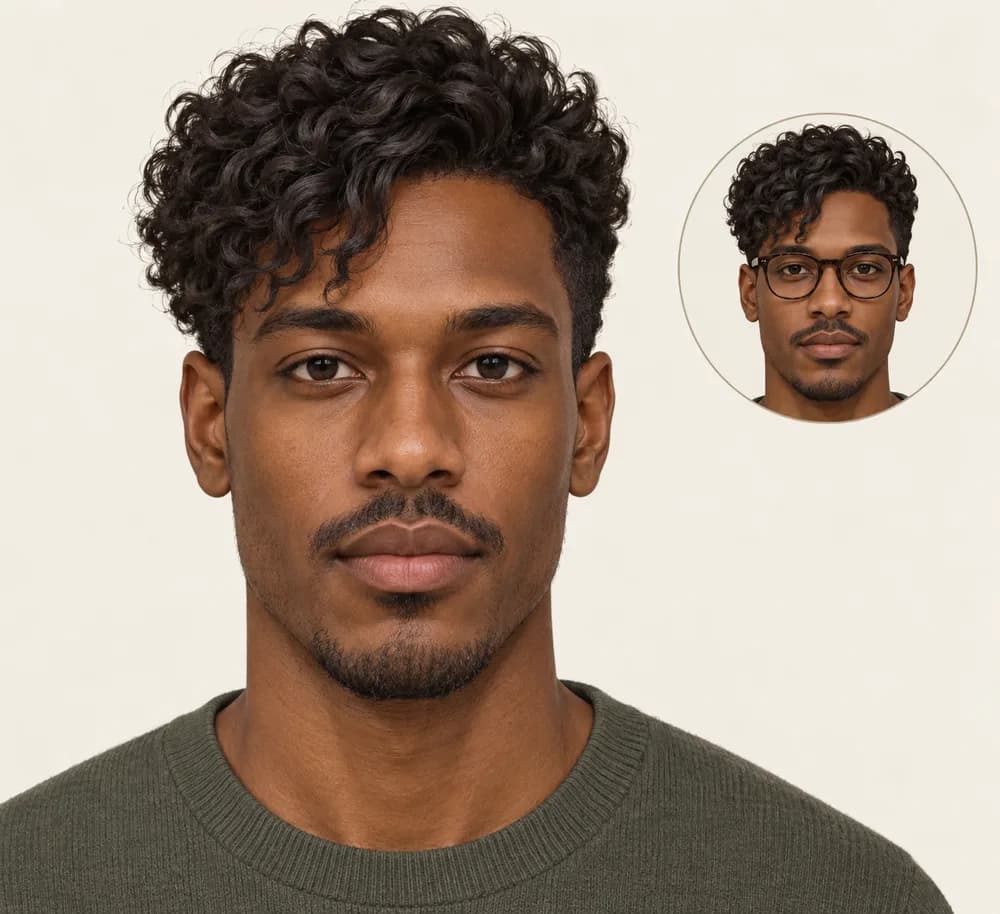
By Zohaib Hassan · Published
This is style guidance, not a medical or scientific assessment. Face-shape categories are a practical shorthand for proportions, and many faces sit between two of them. See our disclaimer.
What is a oblong face shape?
An oblong face, sometimes called rectangular or long, is much longer than it is wide. Forehead, cheekbones and jaw are close in width, so the sides of the face run fairly straight, and the chin can be rounded or squared.
How to tell if your face is oblong
Face length is about 1.55 times cheekbone width or more, and the three widths are within a few percent of each other. In a mirror the outline reads as a long rectangle with softened corners.
Check the outline in a straight-on, eye-level photo with your hair pulled away from your forehead and jaw. Then measure twice: small differences in tape placement can move a borderline face toward a neighbouring shape. Many people genuinely sit between two categories.
- Face length is the dominant measurement.
- Forehead, cheekbones and jaw are similar in width.
- The sides look straighter than an oval face.
- The chin may be rounded or softly square without strong taper.
Oblong face measurements
An oblong face often measures at least about 1.55 times its cheekbone width. Similar horizontal widths are equally important: a long face with strong taper may be oval, diamond or heart.
Measure the widest part of your forehead, the outer cheekbones, the jaw corners and the distance from hairline to chin. Keep every number in the same unit. If two measurements are close, repeat them and use the visible outline as the tie-breaker rather than forcing a precise cutoff.
Oblong vs oval
An oval face tapers from the cheekbones to the chin and is a bit shorter. An oblong face keeps a similar width all the way down and is longer.
For a direct comparison, read the oval face shape guide.
Oblong face shape hairstyles
Oblong face shape hairstyles introduce side-to-side movement and interrupt uninterrupted vertical length. Fringes and side volume are options rather than obligations.
Side-volume curls or waves
Body through cheek and jaw level visually widens the middle.
Textured fringe
Covering part of the forehead shortens visible length.
Jaw- or shoulder-length cut
A horizontal endpoint breaks up length more than flat long hair.
Moderate crown height
Controlled height avoids extending an already strong vertical.
Styling usually adds width and breaks up the length. Fringes, volume at the sides, cuts that end around the cheekbones or jaw, and deeper frames all shorten the face visually. These are balancing ideas, not rules. Repeating your natural geometry can be just as intentional as contrasting it.
Glasses for a oblong face
Glasses for an oblong face can occupy more vertical space. Lens depth and a visible brow line help divide the face.
Deep square frames
Greater lens depth fills vertical space.
Oversized rounded frames
A larger curved lens adds width and contrast when fit is secure.
Browline frames
The upper horizontal line creates a visual break.
Decorative temples
Side detail draws attention outward.
Before buying, check that your pupils sit comfortably within the lenses, the bridge does not slide or pinch, and the temples do not press into the sides of your head. Prescription, comfort and correct optical fit take priority over face-shape advice.
Necklines, earrings and facial hair
Details near the face work by adding direction. Open or V-shaped necklines emphasize vertical space; crew and boat necks add a stronger horizontal. Longer earrings draw down, while studs and clustered shapes hold attention near the cheekbones. Facial hair can soften, widen or square the visible jaw, so assess the bone underneath first and then choose whether to repeat or change that outline.
Common mistakes
- Calling every longer face oblong without comparing widths.
- Adding extreme crown height when balance is the goal.
- Choosing very shallow frames.
- Using a close selfie or low camera angle that exaggerates length.
How this guide was created
This guide uses the same four-part framework on every shape page: face length, forehead width, cheekbone width and jaw width, with jaw curvature used as a visual tie-breaker. Styling suggestions are included only where their visual effect can be explained—for example, adding width near the jaw or creating a vertical line. The portrait above is an original generated editorial illustration, not a photograph of a real person and not proof that every oblong face looks the same.
Face shape is a styling category, not a medical diagnosis, personality indicator or attractiveness score. Age, body composition, dental structure, expression, camera lens and hairstyle can all change how the outline appears. If a sudden or painful facial change concerns you, styling guidance is not a substitute for advice from a qualified health professional.
Oblong face shape FAQ
Is oblong the same as rectangular?
Many systems use them interchangeably; some reserve rectangular for a more angular jaw.
How can I tell oval from oblong?
Oblong is longer with straighter, more even widths. Oval is moderately long and tapers.
Do long hairstyles work on an oblong face?
Yes. Add waves, layers, fringe or side volume so the hair does not form two flat vertical lines.
Compare your result
Use the face shape detector for a private, on-device photo estimate, or follow the four-measurement face-shape method. Face shape is separate from Kibbe image identity; the face shape and Kibbe guide explains how to use both without treating one as a shortcut for the other.