Updated: October 29, 2026
Between Two Kibbe Types? How to Break the Tie and Find Your Real Type
Feel like you're between two Kibbe types? Here are the most common confusing pairs, concrete tie-breaker tests for each, why you can't be two types at once, and what to do next.
Feeling stuck between two Kibbe types is normal. Most people who type themselves end up with two finalists, and the two usually share one key trait while differing on another. The fix is not to call yourself a hybrid. It is to find the one trait the two types disagree on and test it directly.
This guide covers the pairs people confuse most, gives a specific tie-breaker test for each, and explains what to do if the tests still do not settle it.
Why You Feel Between Two Kibbe Types
There are a few predictable reasons:
- Neighboring types share a lot. Types in the same family share a frame. Types in different families can share flesh or face. You will match parts of both descriptions.
- Descriptions are written for the clearest cases. Real bodies are less tidy than type descriptions. You might have the bone width of one type and the curves of another, and both descriptions will seem to fit.
- Self-perception is unreliable. Most of us have strong opinions about our own bodies that do not match how a camera or another person sees us.
- Style preference leaks in. If you love a certain look, you may unconsciously favor the type that matches it.
None of this means your type is unclear. It means the information you have so far is not specific enough.
Can You Be Two Kibbe Types at Once?
No. In Kibbe's system each person has one type, and it does not change over your life. The types are not percentages you combine. They are distinct sets of lines that call for distinct clothing strategies.
The reason is practical. Each type gives you a set of clothing lines: a column versus broken lines, structure versus drape, waist definition versus a straight cut. Those instructions often contradict each other. A Soft Natural needs relaxed, unconstructed shapes; a Soft Classic needs smooth, tidy tailoring with soft edges. You cannot follow both at once. Picking one gives you a clear rule set to test.
Every type in Kibbe's 13-type system is already a blend of yin and yang. A Soft Classic is "Classic plus some yin." When you feel between two types, you are usually feeling that built-in blend, not evidence of a hybrid.
The Most Common Confusing Pairs and Their Tie-Breakers
Soft Natural vs Soft Classic
What they share: Moderate to petite height, softness, some curve, a gentle look.
What they disagree on: Width and bluntness. Soft Naturals have slightly wide, blunt bones under the softness, especially in the shoulders. Soft Classics are narrow and symmetrical, with no noticeable width.
Tie-breaker test: Put on a slightly relaxed, unstructured blazer with a soft shoulder and then a smooth, closely tailored jacket with a softened shoulder line. If the relaxed one looks easy and the tailored one looks stiff or tight across the shoulders, lean Soft Natural. If the relaxed one looks sloppy and the tailored one looks polished, lean Soft Classic.
Full breakdown: Soft Natural vs Soft Classic.
Soft Dramatic vs Flamboyant Natural
What they share: Height or vertical line, a large overall scale, a strong presence.
What they disagree on: Sharpness vs bluntness, and curve. Soft Dramatics have narrow, sharp bones with lush curves and full features on top. Flamboyant Naturals have broad, blunt bones with a straighter, more open body.
Tie-breaker test: Try a draped, waist-defined wrap dress, then a loose, relaxed shirt-dress with no waist. The Soft Dramatic will look best with draping that follows curves. The Flamboyant Natural will look freer and more natural in the unconstructed piece, and may look overly done up in heavy draping.
Related reading: Soft Dramatic vs Soft Natural and the Natural family comparison.
Flamboyant Gamine vs Soft Gamine
What they share: Compact frame, mixed yin-yang, broken lines, lively energy.
What they disagree on: Which side leads. Flamboyant Gamines lead with yang: straight, angular, a little edgy. Soft Gamines lead with yin: a defined waist, curves and rounder features.
Tie-breaker test: Compare a straight, cropped boxy jacket with a short jacket that nips in at the waist. If the boxy jacket looks sharp and the waisted one looks fussy, lean Flamboyant Gamine. If the boxy jacket hides your shape and the waisted one looks right, lean Soft Gamine.
Related reading: Which Gamine Am I? and Flamboyant Gamine vs Classic Gamine.
Dramatic Classic vs Soft Classic
What they share: Moderate height, symmetry, a refined, polished look.
What they disagree on: Edge vs softness. Dramatic Classics have a slight sharpness in bones and features. Soft Classics have a slight softness and curve.
Tie-breaker test: Compare a crisp, sharp-lapel blazer in a smooth, firm fabric with a softly tailored jacket with rounded lapels in a fluid fabric. The sharper jacket will look striking on a Dramatic Classic and harsh on a Soft Classic. The softer jacket will look elegant on a Soft Classic and bland on a Dramatic Classic.
Related reading: Classic vs Dramatic Classic and the Classic family comparison.
Romantic vs Theatrical Romantic
What they share: Petite frame, softness, curves, a lush, feminine look.
What they disagree on: A sharp accent. Theatrical Romantics have small, sharp bone edges and a slightly angular quality under the softness. Romantics are soft and rounded throughout.
Tie-breaker test: Try a fitted dress with a sharp, angular neckline, then the same shape with a rounded, softly draped neckline. If the angular one looks dramatic and polished, lean Theatrical Romantic. If it looks harsh and the rounded one looks right, lean Romantic.
Full breakdown: Romantic vs Theatrical Romantic. If Soft Dramatic is also on your list, see Soft Dramatic vs Theatrical Romantic.
Dramatic vs Dramatic Classic
What they share: Sharp edges, narrow frame, a sleek look.
What they disagree on: Strength of vertical line. Dramatics have a strong, unmistakable vertical line and extreme sharpness. Dramatic Classics are moderate in length with sharpness that is clearly present but toned down.
Tie-breaker test: Wear a floor-length column dress or a very long coat with nothing breaking the line. A Dramatic looks natural and powerful in it. A Dramatic Classic looks slightly swallowed and does better with a knee-length, sharply tailored version. Our Kibbe height guide explains how to judge vertical line.
Related reading: the Dramatic family comparison.
Tie-Breaker Summary Table
| Pair | The deciding trait | Quick test |
|---|---|---|
| Soft Natural vs Soft Classic | Width and blunt shoulders | Relaxed vs tailored jacket |
| Soft Dramatic vs Flamboyant Natural | Sharp + curvy vs blunt + straight | Draped wrap dress vs loose shirt-dress |
| Flamboyant Gamine vs Soft Gamine | Yang lead vs yin lead | Boxy cropped vs waisted cropped jacket |
| Dramatic Classic vs Soft Classic | Edge vs softness | Sharp lapels vs rounded lapels |
| Romantic vs Theatrical Romantic | Sharp accent or none | Angular vs rounded neckline |
| Dramatic vs Dramatic Classic | Strength of vertical line | Floor-length column vs knee-length tailoring |
General Tie-Breaker Tests for Any Pair
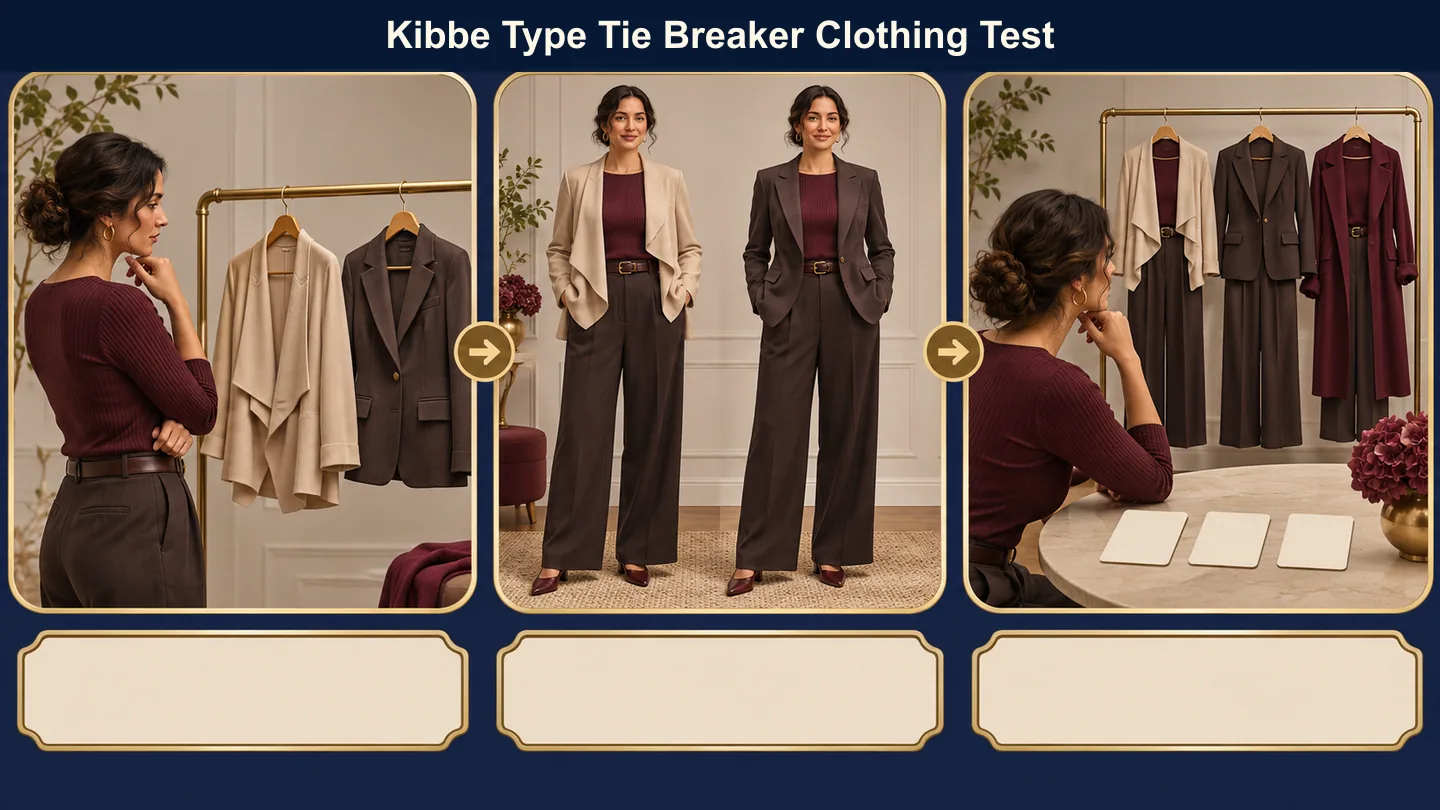
If your pair is not listed above, these tests work for almost any two types.
1. The "first impression" test
Ask two or three people who do not know Kibbe to describe your look in three words. Words like "sharp," "striking" and "sleek" point yang. "Soft," "sweet" and "warm" point yin. "Relaxed" and "sporty" point Natural. "Polished" and "elegant" point Classic. "Cute," "lively" and "spunky" point Gamine.
2. The clothing line test
Kibbe's system is ultimately about which lines suit you. Pick one item that clearly belongs to type A and one that clearly belongs to type B, in the same color. Photograph both. The right one usually makes your body look more like itself; the wrong one makes the clothes look like the focus.
3. The photo distance test
Take a full-length photo from across a room, in fitted, plain clothing. Look at it small, like a thumbnail. Fine details disappear, and the overall shape becomes obvious: long or compact, wide or narrow, straight or curved.
4. The extremes test
Ask which extreme you can tolerate. If very sharp tailoring looks fine on you but frills look silly, you have more yang. If ruffles look natural and stiff tailoring looks severe, you have more yin. This often breaks ties within a family.
5. The "what goes wrong" test
Look at your worst outfits. The way clothes fail is often more telling than the way they succeed. Do things look tight across your shoulders (width)? Sloppy and shapeless (you need more structure or waist)? Overwhelming (you need smaller scale)?
Mistakes That Keep You Stuck Between Types
- Typing by weight or body shape. Your weight can change; your type does not. A curvy Flamboyant Natural is still a Flamboyant Natural. See weight gain patterns by type.
- Typing by face alone. Faces matter, but body lines usually decide close calls.
- Typing by style preference. Loving bohemian clothes does not make you a Natural.
- Typing by height alone. Inches are a clue, not a verdict.
- Changing your answer every week. Pick one and test it properly before switching.
Our common Kibbe mistakes post covers these in more depth.
Practical Next Steps
- Write down your two finalists and the single trait they disagree on. Use the table above as a starting point.
- Run the specific tie-breaker test for that trait. Use photos, not the mirror.
- Retake the Kibbe body type quiz and answer based on what you see in photos, not what you wish were true.
- Get an outside view. Upload photos to our photo analysis tool for a second opinion on your lines.
- Commit to one type for a month. Dress by its lines and note how you feel and how others react. If it consistently feels wrong, switch to the other finalist and repeat.
- Read both full type guides. Every type is described in detail on the 13 Kibbe types page. Answers to common questions are on the FAQ.
The goal is not a label for its own sake. The right type is the one whose clothing guidelines make dressing easier and make you look more like yourself.
FAQ: Between Kibbe Types
What if I'm between Kibbe types and nothing settles it?
Go with the type whose clothing works best in practice. Kibbe's system exists to help you dress, so the type that gives you the most wearable, flattering results is the most useful answer.
Can my Kibbe type change?
No. Your bone structure and overall lines stay the same through weight changes, pregnancy and age. What changes is how you feel about your body, which can make a different type seem right.
Are some types more often confused than others?
Yes. Soft Natural vs Soft Classic and the Gamine types are among the most common points of confusion, along with the Dramatic Classic vs Dramatic boundary.
Is it better to choose the softer or the sharper type when unsure?
There is no default. Run the extremes test above. If you still cannot tell, test the softer type for a month first, then the sharper one, and compare photos.
Related Guides
Continue with the closest comparison or practical next step for this topic.
Discover Your Kibbe Type
Take our interactive quiz to find out your body type and get personalized styling recommendations.
Take the Quiz