Updated: October 29, 2026
Kibbe Height Guide: Vertical Line, Height Cutoffs and What Height Each Type Is
Are there Kibbe height cutoffs? How vertical line differs from actual height, typical height ranges for each Kibbe family, petite vs tall types, and a table of all 13 types.
Kibbe does not use strict height cutoffs. What matters in the Kibbe system is vertical line: whether your body looks long and elongated, moderate, or compact. Actual height is a strong clue, and most people's vertical line matches their measured height, but it is an impression, not a rule. A 5'4" woman can read as long, and a 5'8" woman can read as compact.
This guide explains how vertical line works, the typical height ranges you will see in each family, and why the numbers should guide you rather than decide for you.
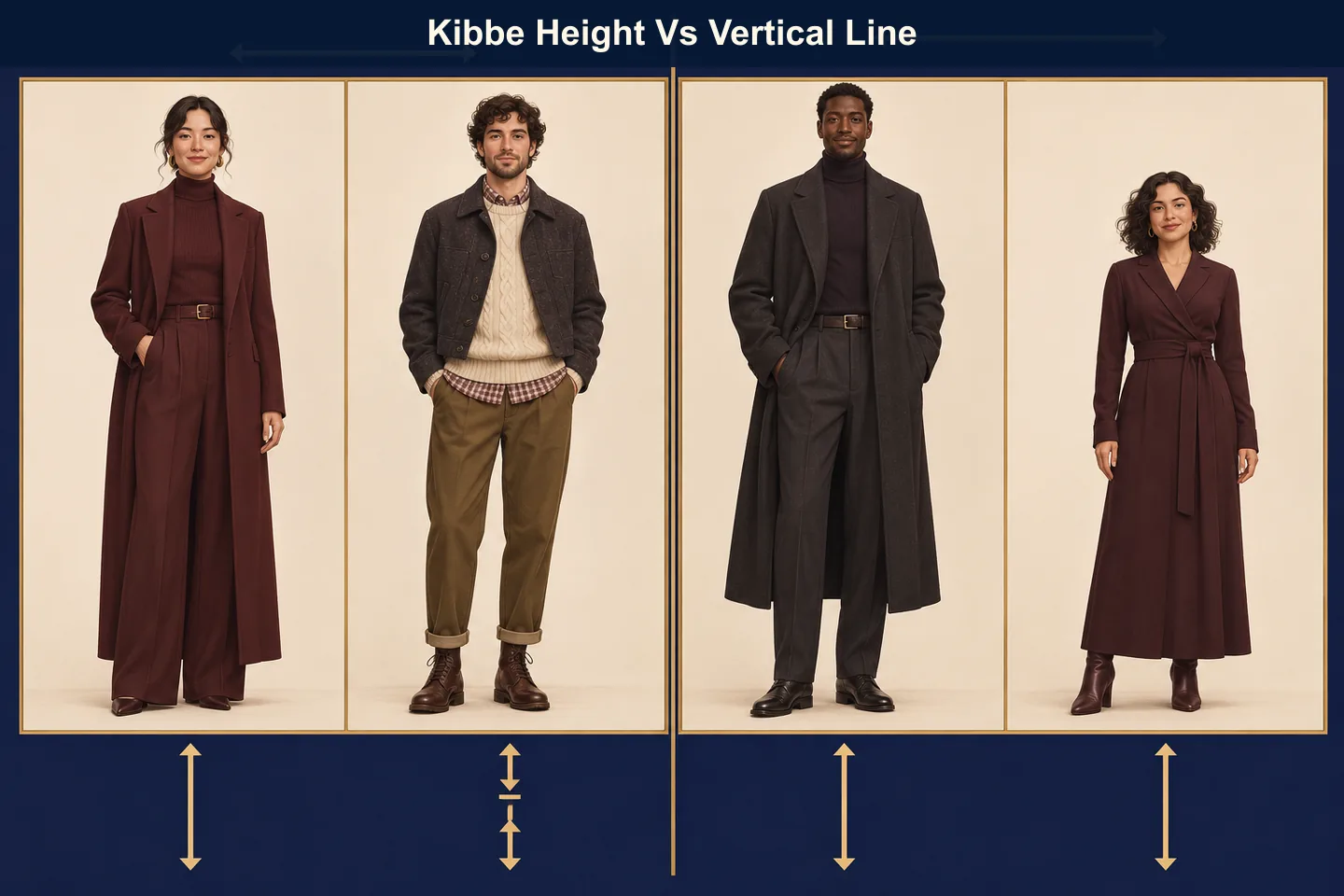
Kibbe Height vs Vertical Line
What vertical line means
Vertical line is the visual sense of length in a body. When someone has it, your eye travels up and down: the limbs look long, the neck looks long, and the whole frame seems stretched along a vertical axis.
Vertical line is a yang quality in Kibbe's framework. Dramatics have the most of it. Gamines and Romantics have the least. Classics sit in the middle.
What creates the impression
Several factors feed into vertical line besides measured height:
- Limb length relative to torso. Long legs and arms create length even on a shorter frame.
- Neck length. A long neck adds a surprising amount of perceived height.
- Narrowness. A narrow frame looks longer than a wide one of the same height.
- Bone sharpness. Sharp, straight bones emphasize length; rounded shapes shorten.
- Head-to-body ratio. A small head on a long body reads taller.
That is why two people of the same height can land in different families.
How to test your vertical line
Try this at home:
- Put on a long, unbroken column outfit: one color, top to bottom, with a long coat or long cardigan.
- Compare it with a broken outfit: a cropped top or short jacket, contrasting bottoms, ankle-length trousers.
- Photograph both from head to toe, at hip height, without heels.
If the column looks natural and the broken outfit chops you up, you probably have vertical line. If the column swamps you and the broken outfit looks lively and balanced, you probably do not.
Are There Kibbe Height Cutoffs?
Not officially. Kibbe has discussed height many times, and his consistent point is that height is a strong starting signal, not a final answer. The rough guidance that circulates in the Kibbe community looks like this:
- About 5'7" (170 cm) and taller: Very likely to read as having vertical line. Being a petite-reading type at this height is unusual.
- About 5'5"–5'7" (165–170 cm): The overlap zone. Any family is possible depending on bone structure and proportions.
- About 5'4" (163 cm) and under: Most people read as moderate or compact. Some still read long, especially with very long limbs and a narrow frame.
Treat these as tendencies. People who type themselves strictly by inches are one of the most frequent sources of mistyping we see. If you want to double-check, see our list of common Kibbe mistakes.
Why heels and posture do not count
Kibbe assesses the body as it naturally is. Heels add inches but not vertical line, and posture changes how you carry the frame, not its proportions. Type yourself barefoot, standing naturally.
What Height Is Each Kibbe Type? Typical Ranges by Family
The ranges below describe where each family usually falls. They are not requirements.
Dramatic family: long and narrow
Dramatics and Soft Dramatics have strong vertical line. Most are 5'7" and up, and many are much taller. Shorter Dramatics exist, but they will have unusually long limbs, a narrow, sharp frame and a body that reads elongated in photos.
Natural family: width plus some length
Flamboyant Naturals carry vertical line along with blunt width, so they usually range from about 5'6" upward. Soft Naturals are usually moderate to petite, often 5'2"–5'6". (Pure Natural, which appears in the original system, sits in between.)
Classic family: moderate
Classics read as moderate, neither long nor short. Most are around 5'3"–5'7". Dramatic Classics can sit at the higher end and show a little more length; Soft Classics often sit at the lower end.
Gamine family: compact
Gamines read small and close together. Most are 5'5" and under, and many are well under 5'3". The compact impression matters more than the number. See Gamine meaning for how Kibbe defines the family.
Romantic family: petite and soft
Romantics and Theatrical Romantics usually read petite, most often 5'5" and under. Their shortness comes with softness and curve rather than sharp, broken contrast.
Dramatic Classic Height
Dramatic Classic is one of the most searched height questions, because the type sits between two families.
Dramatic Classics usually read moderate with a slight lean toward length. Most fall roughly in the 5'4"–5'8" range. The "dramatic" part of the name refers mainly to sharper, more angular bone edges and a crisper overall look, not to great height. A Dramatic Classic does not have the strong, unmistakable vertical line of a true Dramatic.
If you are tall and very angular, compare carefully with Dramatic. If you are moderate in height and look polished in sharp tailoring, Dramatic Classic is more likely. Our Classic vs Dramatic Classic comparison covers the other side of the boundary.
Kibbe Height Table: All 13 Types
| Kibbe type | Vertical line | Typical height impression | Common range (guide only) |
|---|---|---|---|
| Dramatic | Strong | Tall, long, narrow | 5'7"+ |
| Soft Dramatic | Strong | Tall, long, with curves | 5'7"+ |
| Flamboyant Natural | Moderate to strong | Tall-ish, broad, open | 5'6"+ |
| Natural | Slight | Moderate, relaxed | 5'4"–5'8" |
| Soft Natural | Little to none | Moderate to petite, soft width | 5'2"–5'6" |
| Dramatic Classic | Slight | Moderate, slightly elongated | 5'4"–5'8" |
| Classic | None | Moderate, balanced | 5'3"–5'7" |
| Soft Classic | None | Moderate, soft | 5'2"–5'6" |
| Flamboyant Gamine | None | Compact, sharp | 5'5" and under |
| Classic Gamine | None | Compact, neat | 5'5" and under |
| Soft Gamine | None | Compact, curvy | 5'5" and under |
| Theatrical Romantic | None | Petite, delicate | 5'5" and under |
| Romantic | None | Petite, soft, lush | 5'5" and under |
For a broader side-by-side view of all traits, not just height, see the Kibbe body types chart.
Petite Kibbe Types vs Tall Kibbe Types
Types that usually read petite
- Flamboyant Gamine, Classic Gamine, Soft Gamine
- Romantic, Theatrical Romantic
- Often Soft Natural and Soft Classic
These types look best in clothes scaled to a smaller frame. Long hems, huge prints and big, heavy fabrics tend to overwhelm them.
Types that usually read tall
- Dramatic, Soft Dramatic
- Flamboyant Natural
These types can carry length, scale and volume. Cropped, fussy or very small-scale pieces tend to look cut off on them.
The middle
Classics and Naturals are the moderate types. They do best with moderate lengths and moderate scale: knee-length hems, mid-size accessories and clean, unexaggerated cuts.
Why Short People Can Read Vertical (and Tall People Compact)
A short person with vertical line
Picture a 5'4" woman with a narrow frame, very long legs, a long neck and sharp bones. In a long coat she looks elegant; in a cropped jacket and ankle trousers she looks chopped in half. Even though she is technically petite, her body is asking for length. She could be a Dramatic or a Soft Dramatic.
Kibbe is known for typing some shorter women as Dramatic or Soft Dramatic for exactly this reason. Their measured height says "petite," but their proportions say "long."
A tall person without vertical line
Now picture a 5'7" woman with a short neck, a long torso and shorter legs, rounded shoulders and a soft, curvy body. A long column outfit makes her look heavy and sunk into the fabric, while a fitted, waisted dress with a hem above the knee looks great. She may read moderate or even compact, and could land in the Classic or Gamine family.
What these cases teach
Height is just the first filter. The real question is what your body does with that height. The how to find your Kibbe body type guide walks through the full assessment, and the Kibbe facial features guide explains how your face fits in.
How to Dress for Your Height Impression
Once you know whether you read long, moderate or compact, a few rules follow:
- Long (strong vertical line): Use the length. Floor-length coats, long hems, full-length trousers and column outfits all work. Avoid chopping yourself up with many contrasting pieces and very cropped lengths.
- Moderate: Aim for moderate everything. Knee-length hems, hip-length jackets and full-length but not pooling trousers keep the balance. Extremes in either direction look forced.
- Compact: Embrace shorter lengths and scale. Cropped jackets, ankle trousers and above-knee skirts suit you. Long, heavy fabrics and oversized shapes tend to swallow a compact frame.
If you dress for your height impression rather than your measured height, your outfits will usually look right even before you settle on an exact type.
Common Height Mistakes in Kibbe Typing
- "I'm 5'3", so I can't be Dramatic." Possible, just less common. Test vertical line with clothing rather than ruling it out.
- "I'm 5'8", so I must be Dramatic." Tall Naturals, Soft Dramatics and Classics are all common. Check bone sharpness and width.
- "Gamines are short, so every short person is a Gamine." Shortness alone is not enough. Gamines need the mixed yin-yang contrast; a short, all-soft person may be a Romantic.
- "A small height change automatically changes my profile." Height is only one observation in this site's comparisons. Posture, age and measurement error can affect the number, so do not move between profiles from a small measurement difference alone.
Kibbe Height FAQ
What is the Kibbe height cutoff for Dramatic?
There is no official cutoff. Most Dramatics are 5'7" or taller, but shorter women with a long, narrow, sharp frame can still be Dramatic.
Can a tall woman be a Gamine?
It is uncommon above about 5'6", but not impossible. The frame has to read compact and the body has to look best in cropped, broken lines.
Do men use the same height ranges?
The principle is the same, but the numbers shift up because men are taller on average. See our Kibbe for men guide for male typing.
How do I know if I have vertical line?
Use the column-versus-broken-outfit test above, and pay attention to which looks natural in photos. The Kibbe body type quiz includes height and vertical line questions, and the photo analysis tool gives a second opinion from your pictures.
Is height the most important factor in Kibbe?
No. Height is one input into vertical line, and vertical line is one input into your type. Bone structure, flesh and facial features all count. Browse all 13 types to see how the pieces combine.
Related Guides
Continue with the closest comparison or practical next step for this topic.
Discover Your Kibbe Type
Take our interactive quiz to find out your body type and get personalized styling recommendations.
Take the Quiz