Updated: October 29, 2026
Gamine Meaning: Definition, French Origin and the Kibbe Gamine Types
What does gamine mean? The dictionary definition, where the French word comes from, how gamine became a style archetype on screen, and how David Kibbe uses Gamine for three compact body types.
Gamine describes a girl or young woman with a slim, small-boned, often boyish look and a mischievous, lively charm. The word comes from French, where gamin means a street kid and gamine is the feminine form. In fashion, gamine names a style built on short hair, cropped lines and a playful, slightly tomboyish energy. In the Kibbe body type system, Gamine is one of five families: a compact frame that mixes sharp (yang) and soft (yin) qualities side by side.
This guide covers all three meanings: the dictionary sense, the style archetype, and the Kibbe body types.
Gamine Meaning: The Dictionary Definition
If you look up "gamine" in a standard English dictionary, you will usually find two senses:
- A street urchin girl. This is the older, literal meaning, carried over from French. It is rarely used this way in English today.
- A girl or woman with an impish, mischievous, boyish appeal. This is the meaning most people intend now. It suggests someone slight, quick, youthful and a bit cheeky.
The word works as both a noun and an adjective:
- Noun: "She was the classic gamine of 1950s cinema."
- Adjective: "a gamine haircut," "her gamine features," "a gamine silhouette."
How to define gamine in one sentence
A simple way to define gamine: a slim, youthful woman whose charm comes from playfulness and a hint of tomboyishness rather than conventional glamour.
Notice what the gamine definition does not say. It does not mean simply "petite" or "thin." The spark, the mischief and the slightly boyish edge are what make the word fit.
Pronunciation
Gamine is pronounced ga-MEEN, with the stress on the second syllable. The masculine gamin is pronounced roughly GAM-in in English, or ga-MAN (nasal ending) in French.
The French Origin of Gamine
The root word is the French noun gamin, meaning a boy who runs around the streets, a scamp or urchin. Its deeper origin is uncertain. It shows up in French writing in the early 1800s, and Victor Hugo's Les Misérables (1862) made the figure famous through Gavroche, the cheeky Parisian street boy. Hugo even devoted a section of the novel to describing the Paris gamin as a type.
Gamine is simply the feminine form. English borrowed both words in the 1800s. Over time the English meaning drifted. The street-kid sense faded, and what remained was the attitude: quick, irreverent, youthful and unpolished in a charming way.
That shift matters. When English speakers call someone gamine today, they are pointing to a look and an energy, not to poverty or the street.
| Word | Language | Literal meaning | Modern English use |
|---|---|---|---|
| gamin | French (masculine) | Street boy, urchin | Rare; a mischievous boy |
| gamine | French (feminine) | Street girl, urchin | A slim, impish, boyish-charming woman |
| gamine | English adjective | — | Describing a style, haircut or features |
Gamine as a Fashion and Style Archetype
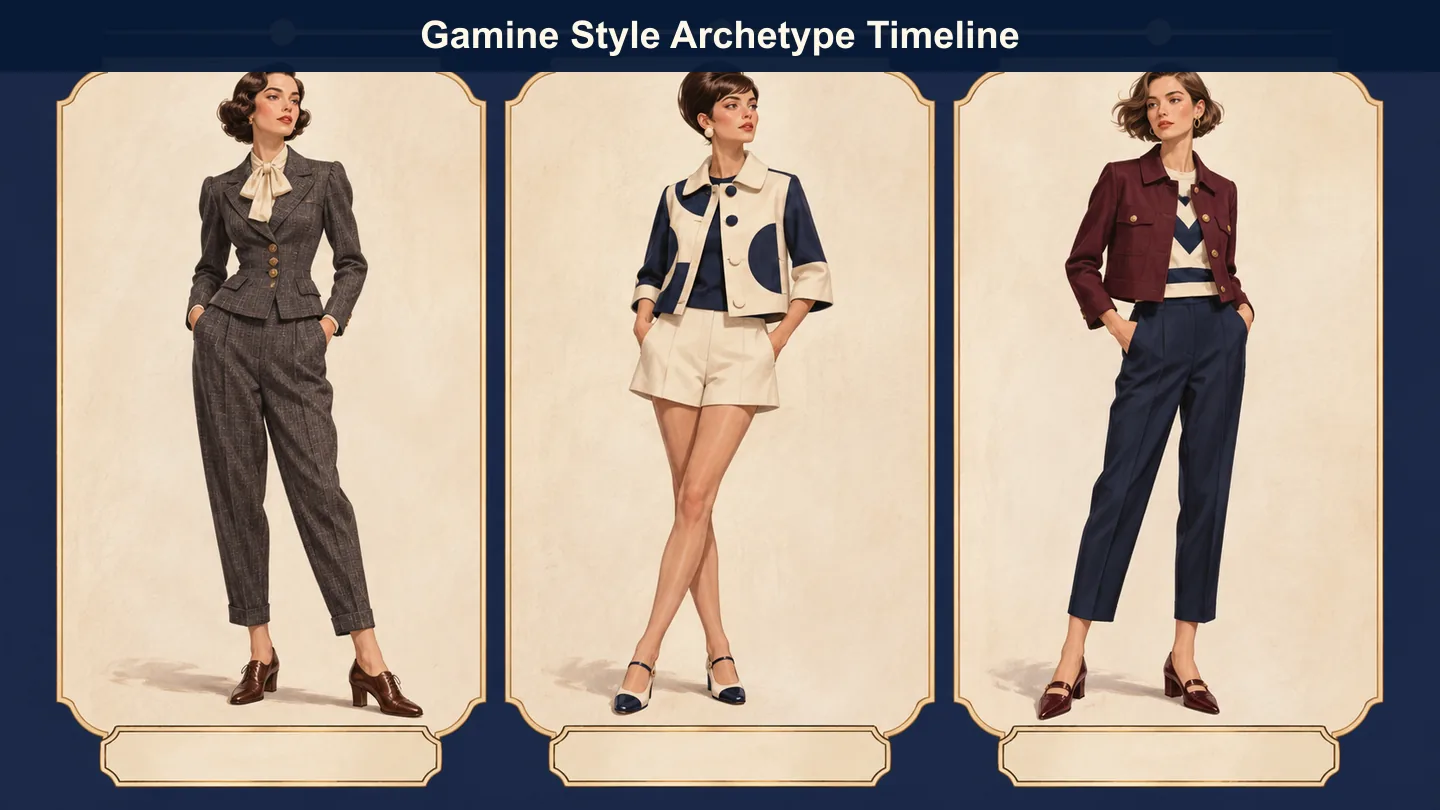
The gamine became a recognizable screen type in the 1950s and 1960s. Filmmakers and fashion editors used the word for a new kind of leading lady: not the curvy bombshell, but a slender, short-haired woman with wide eyes and a sense of fun.
Classic film examples of gamine style
- Audrey Hepburn is the reference point most people reach for. Her look in Roman Holiday (1953), Sabrina (1954) and Funny Face (1957) set the template: cropped trousers, ballet flats, slim black turtlenecks and a short fringe.
- Leslie Caron in An American in Paris (1951) and Gigi (1958) brought a dancer's lightness and a cropped bob to the archetype.
- Jean Seberg in Breathless (1960) wore a pixie cut, a striped Breton top and a newspaper-seller's T-shirt, and the image is still copied today.
- Mia Farrow in Rosemary's Baby (1968) made the very short pixie cut a symbol of the era.
- Twiggy, the 1960s model, took the gamine look into mod fashion with short shift dresses, bold eye makeup and a boyish crop.
The core elements of gamine style
Across those examples, a few elements repeat:
- Short or cropped hair: pixie cuts, short bobs, blunt fringes
- Cropped lengths: ankle trousers, short jackets, mini or above-knee skirts
- Slim, neat fit: nothing oversized or flowing
- Graphic contrast: black and white, stripes, polka dots, color blocking
- Flat shoes: ballet flats, loafers, low boots
- A playful detail: a bright scarf, oversized sunglasses, a bold lip
In everyday fashion writing, "gamine style" means this kind of look regardless of your actual body type. Kibbe uses the same word in a narrower and more specific way.
Gamine in Kibbe: What the Word Means in Body Typing
In his 1987 book Metamorphosis, stylist David Kibbe borrowed "Gamine" as the name for one of his five image families. He chose it because the people in this family often carry the same spirited, youthful energy as the screen gamines. But in Kibbe's system, Gamine is defined by body lines, not by haircut or attitude.
The Kibbe Gamine family: yin and yang side by side
Kibbe describes every body using two forces:
- Yang: sharp, angular, straight, long, bold
- Yin: soft, rounded, curved, small, delicate
Most families blend these. Classics, for example, show a smooth, even balance. Gamines are different. They show yin and yang next to each other, without blending. A Gamine might have a small, petite frame (yin) with sharp, straight bone edges (yang), or a compact build with a bold, angular face. The effect is contrast in a small space.
That is why Gamine clothing is built on broken lines: separates, color blocking, cropped lengths and lots of small details. A single long, unbroken column, which works so well for a Dramatic, tends to swamp a Gamine.
The compact frame
The second defining trait is compactness. Gamines read as small-scale and close together. They usually have:
- No strong vertical line (they do not look long or elongated)
- No strong width (they do not look broad or blunt)
- Proportions that feel neat and contained
Most Gamines are petite in actual height, often 5'5" or under, but Kibbe always stresses the visual impression over the tape measure. If you want the full explanation, our Kibbe height guide covers how vertical line and real height relate.
Gamine is not the same as "gamine style"
This is the most common confusion around the word. Someone with a short haircut and a love of striped tops has gamine style. Being a Kibbe Gamine depends on your bones and flesh. A tall Dramatic can wear a pixie cut, and a Kibbe Soft Gamine may have long, curly hair. Keep the two meanings separate and the system becomes much easier to use.
The Three Kibbe Gamine Types
Kibbe's original 13-type system lists three Gamines. All share the compact, mixed frame; they differ in which side of the mix leads.
Flamboyant Gamine (yang-leaning)
The Flamboyant Gamine is the sharpest of the three. The frame is compact, but the bones are straight and angular, the shoulders can look squared, and the face often has strong, defined features. The overall impression is bold, energetic and a bit edgy. Flamboyant Gamines look best in crisp, close-fitting pieces with sharp details and strong contrast.
Classic Gamine (even mix)
The Classic Gamine, called simply "Gamine" in Metamorphosis, is the evenly mixed version. Neither the sharp nor the soft side clearly takes over. The look is neat, tidy and playful. Clean, tailored separates with small, crisp details are the sweet spot. In Kibbe's current 10-type system this type is no longer listed on its own, so people who fit it usually choose between Flamboyant Gamine and Soft Gamine.
Soft Gamine (yin-leaning)
The Soft Gamine has the same compact frame, but with more curve and softer flesh over a slightly sharp bone structure. There is usually a defined waist and a rounder face. The impression is sweet, lively and approachable. Soft Gamines need fitted shapes that follow the waist, plus playful, rounded details.
| Flamboyant Gamine | Classic Gamine | Soft Gamine | |
|---|---|---|---|
| Yin/yang | Yang leads | Even mix | Yin leads |
| Body line | Straight, angular | Neat, compact | Curvy, waisted |
| Face | Sharp, defined | Mixed, crisp | Rounder, fuller |
| Key style word | Bold | Tidy | Sweet |
| Best details | Sharp, geometric | Small, crisp | Rounded, playful |
Not sure which of these fits you? Our comparison post Which Gamine Am I? walks through each one head to toe and ends with a five-question self-test.
How to Dress Gamine Style
Whether you are a Kibbe Gamine or simply like the look, these principles produce a gamine outfit that feels intentional.
1. Break the line
Wear separates rather than one long piece. A cropped jacket over trousers, a sweater tucked into a skirt, or a belted dress all create the "broken" effect. Color blocking does the same job.
2. Keep it cropped and close
Choose ankle-length trousers, short jackets, above-knee skirts and fitted knits. Fabric should follow the body without clinging or hanging. Oversized and flowing pieces tend to hide a gamine frame.
3. Add contrast
Gamine outfits rely on visual contrast: black with white, navy with red, stripes with solids. Kibbe Gamines in particular look washed out in head-to-toe blended neutrals.
4. Use small, playful details
Think contrast piping, patch pockets, short scarves, small bold earrings, buttons that stand out. One or two details per outfit is plenty for Flamboyant Gamines; Soft Gamines can carry a few more.
5. Choose flat or low shoes
Ballet flats, loafers, ankle boots and clean sneakers all fit the youthful, mobile energy of the archetype.
Sample gamine outfits
- Weekday: Navy-and-white striped top, black cropped cigarette trousers, red ballet flats, small gold hoops.
- Office: Short, fitted blazer, crisp white shirt, slim ankle trousers, loafers with a buckle.
- Weekend: Cropped denim jacket, black fitted tee, straight jeans cut at the ankle, white sneakers.
- Evening: Short black dress with a defined waist and a contrast collar, bold short earrings, low block heels.
For denim specifically, see our guide to the best jeans for Kibbe body types, which covers each Gamine separately.
Gamine vs Similar Terms
Gamine is often confused with a few nearby words:
- Petite: A size and height category. Petite describes measurements only; gamine also implies personality and contrast.
- Waif: Suggests thinness and fragility. Gamine is lively and confident rather than fragile.
- Tomboy: Overlaps with gamine, but tomboy is about behavior and interests. Gamine adds a polished, stylish element.
- Ingénue: A sweet, innocent young character. The gamine is more mischievous.
- Kibbe Romantic: Also often petite, but pure yin: soft, rounded and lush, with no sharp edge. Gamines always have some yang. Read more in our Romantic family comparison.
Gamine FAQ
What does gamine mean when describing a woman?
It means she has a slender, youthful, slightly boyish look combined with a playful, mischievous charm. It is usually a compliment about style and energy rather than body size.
Is gamine a compliment?
In modern English, yes. It suggests charm, energy and an effortless, chic look. The old "street urchin" sense is almost never what people mean today.
What is the gamine definition in Kibbe?
In the Kibbe system, a Gamine has a compact frame that combines yin and yang side by side instead of blending them. There are three Gamine types: Flamboyant Gamine, Classic Gamine and Soft Gamine.
Can you be tall and gamine?
In everyday fashion, yes: anyone can wear gamine style. In Kibbe typing, tall people rarely read as compact, so most Kibbe Gamines are on the shorter side. A moderately tall person can still be a Gamine if her overall frame reads small and contained.
What is the difference between gamine and petite?
Petite only describes size. Gamine describes a look and an energy. In Kibbe, a petite person can be a Gamine, a Romantic, a Theatrical Romantic or even a Soft Classic, depending on her lines.
How do I find out if I'm a Kibbe Gamine?
Start with the Kibbe body type quiz, which asks about bone structure, flesh and facial features. If you want a second opinion based on photos, try the photo analysis tool. You can also browse all 13 Kibbe types to compare the Gamine family with the others.
Related Guides
Continue with the closest comparison or practical next step for this topic.
Discover Your Kibbe Type
Take our interactive quiz to find out your body type and get personalized styling recommendations.
Take the Quiz